

Thank you for visiting!


_/\_/\_


 One Single Impression

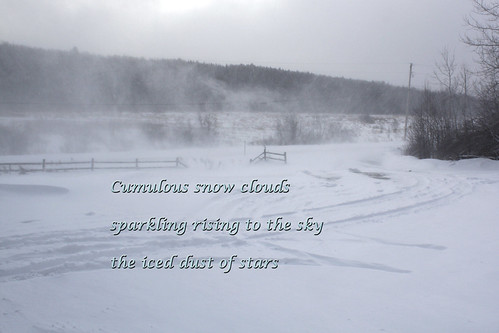 One Single Impression
 Quietly the sunOne Single Impression or One Single Impression
Good question! I'm sure you've googled; you'll get a lot of information if haven't and then do. But here's what I've learned about it so far:from the teach:
The kireji is a definite break in the haiku. Not just a pause like a comma would make in one complete sentence, but a full break or change so that the haiku is not one complete sentence in three lines. E.g., I believe in yours it would come after "woods." (BTW, you could leave out that dash, if you wanted, as it's clear there's a cut or break without it.)
Why is this kireji also often called "the cutting word"? Because (if I am recalling correctly) in Japanese there would be an actual word that creates this cut, this stop. In Japanese this cutting word/kireji has no meaning except as a sort of "stop sign" within a haiku (and there are various sorts of kireji). Whereas in English we don't need a word to indicate a stop, because our grammar itself indicates when a sentence or sentence fragment is done, over, stopped. Some haiku writers have used/do use dashes and colons to indicate the cut/kireji. But usually English grammar makes it just as clear without any extra punctuation.
Hope that was even a little helpful. Kireji is an extensive study, judging by the little bit of it I've dipped my toes into.
Yes you do understand the "cutting word," Andree! "field of trout lilies!" It's an exclamation at the end of a haiku - "I walk in the woods/earth black with seeping water/ --trout lilies!and from Crafty Green Poet:
A surprise, in your haiku you've come upon the trout lilies and it surprised you and us the readers...:D
My understanding is that the cutting word can't be directly translated, but instead in English is replaced by a dash at the end of the first or second line(like at the end of your first line) to separate the two parts of the haiku. - generally the image in the first part of the haiku makes a comparison or contrast with the image in the second part of the haiku. That's my understanding anyway!

 Saplings at woods edge — One Single Impression or One Single Impression
 Coyote appears
 Geese glide on snow melt

| BEFORE you thought of spring, Except as a surmise, You see, God bless his suddenness, A fellow in the skies Of independent hues, A little weather-worn, Inspiriting habiliments Of indigo and brown. With specimens of song, As if for you to choose, Discretion in the interval, With gay delays he goes To some superior tree Without a single leaf, And shouts for joy to nobody But his seraphic self! Emily Dickinson |
 Eastern Blue Bird (Sialia sialis) first seen by Mr. T on 17 April 2008

 Sweet delicate sap
 Heart's ice bends me lowWhen clicked, this photo will open, full size, in a new window.
 Laughing eyes run up to me.When clicked, this photo will open, full size, in a new window.


